
- Workshop 1: Growth Snapshot
- Workshop 2: Growth Roles
- Workshop 3: Brand, Tech, & Tools
- Workshop 4: Priority Markets
- Workshop 5: Ideal Profiles
- Workshop 6: Playbook & Plan

Timing & Participation
Workshop: 1 of 6
Duration: 60 minutes
Led by: MiM™ Coach
Participants: CEO / President / Owner, plus key leaders from Operations, Sales, and Marketing
This is the first workshop that uses the MiM™ Teach / Gather rhythm.
The session begins with a short teaching segment to establish shared context and language. From there, the majority of the time is spent in Gather on your working whiteboard — guiding the leadership team through structured conversation to understand how revenue moves through the business today.
The Coach’s role in this session is to facilitate clarity — helping leaders surface patterns around customer mix, generational relationships, sales channels, and growth goals without turning the conversation into a data review.
This workshop sets the baseline understanding the rest of Quick Start™ builds on.
Preparation
Time Required: 15–20 minutes
Lead: MiM™ Coach
Timing: 1–2 days before the workshop
Preparation for the Growth Snapshot is intentionally light. The goal is to prime leadership thinking so the session surfaces patterns quickly — not to validate data or debate numbers.
Use the steps below to prep for your Growth Snapshot session.
To: Client Team
Cc: MiM™ Architect
Subject: Workshop 1: Growth Snapshot Prep—————-
Hi team,
I’m looking forward to our upcoming Growth Snapshot session. This workshop is our chance to look at where and how revenue comes into your business so we can spot patterns, gaps, and opportunities to create more growth with less friction.
To make the most of our time together, please send over your responses to the questions below before we meet. High-level estimates are totally fine — we’re looking for direction, not precision. This should take about 5–10 minutes.
Anyone on the invite is welcome (and encouraged) to respond. If answers differ from person to person, that’s helpful for us to see — those differences often reveal important insights we’ll explore together in the session.
- How many customers do you currently have?
- How many of those customers have been with you for 10+ years?
- How many have been with you between 5–10 years?
- What are the names of 2–3 customers who have been with you the longest?
- What revenue streams exist today? (Client service work, e-commerce, product licensing, etc.)
- How do you sell your product today? (Direct, distributor, reps, online, etc.)
- What are your top-line revenue goals for the next 1, 3, or 5 years?
- Do you have a documented plan for how you’ll hit those numbers?
If you don’t have an answer for something, just note that when you send your responses. That’s useful for us to understand as well.
Looking forward to our time together — reach out with any questions beforehand.
Talk soon,
MiM™ Coach
This should already be on the calendar at this point, but as a quick reference point, this should be your calendar invite.
*Client Name* // Workshop 1: Growth Snapshot
Required: Client leader, Client team, MiM® Coach, MiM® Architect—————-
Meeting Room: *Zoom or Teams info*
Purpose: In this session, we’ll dig into your customer mix, sales channels, and documented company goals so we can understand how revenue actually moves through your business. You’ll receive a short prep email beforehand with a few specifics to gather so we can hit the ground running.
- Open the Quick Start™ – Growth Snapshot Teach deck in Canva
- Use Presenter View to review your speaking notes
- Practice transitions
- Focus on flow, not memorization
This session is a teaching performance — you need to be fluent, confident, and conversational.
Quick Start™ – Growth Snapshot Teach Deck by Beth BarbagliaIf you receive answers back from the client via email, use them to start filling in your whiteboard.
Teach
Time: ~10–15 minutes
Lead: MiM™ Coach
There are 2 ways of presenting the deck. Either approach works — the goal is to keep customer experience smooth, while equipping you with the tools you need.
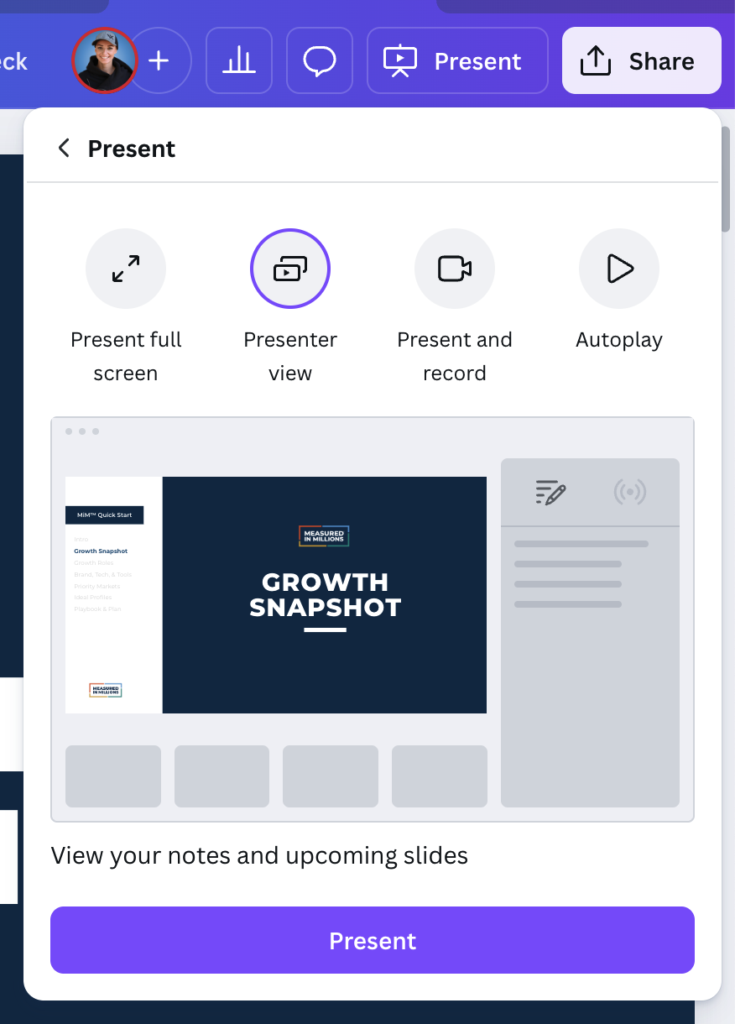
If you need to reference Presenter Notes, go to the deck in Canva and click Present. Choose Presenter View, then click Present.
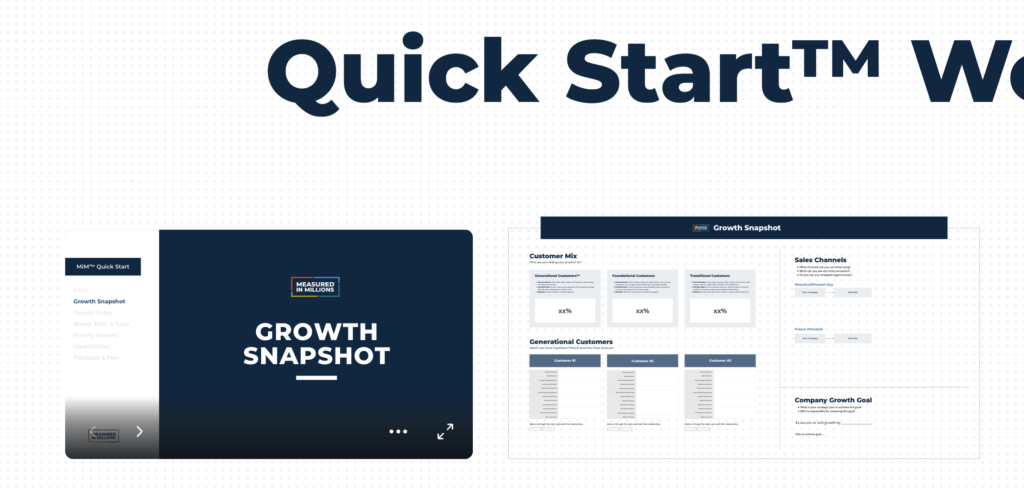
If you’re presenting from the whiteboard, double click the presentation to interact with it. This should allow you to navigate slides now.
You can either zoom in so it fills the screen appropriately, or use the expand arrows to take the deck full screen.
Note: You can’t see presenter notes in this format.
Once you’ve gone through the Teach portion, simply move your screen over on the whiteboard and start your intake session.
Use the Growth Snapshot slides to reinforce the relationship-first lens, explain the three customer types at a high level, frame the session as pattern discovery, not performance review.
Once the lens is clear, move into Gather.
Gather
Time: ~45-50 minutes
Lead: MiM™ Coach
The Gather portion of Growth Snapshot is where the session shifts from teaching into conversation. Your role here is not to extract data — it’s to surface patterns, stories, and shared understanding about how growth really happens inside the business.
Use the Growth Snapshot whiteboard as your guide to anchor the discussion.
While the prep questions we sent via email provide structure, the session itself should feel more like story time than a systematic intake. You’re not auditing the business — you’re helping leaders narrate how growth has actually unfolded.
Start by orienting the room. Using the prep answers, work with the team to estimate the current mix of:
- Generational Customers
- Continuity Customers
- Transitional Customers
This doesn’t need to be exact. The goal is to establish a directional understanding of where revenue and relationship depth live today. Often, leaders have never seen their customer base framed this way — that insight alone creates momentum.
If the team knows how many long-tenured customers they have and roughly how many total customers exist, you can deduce percentages together in real time.
Next, go deeper into the relationships that matter most. Walk the team through 2–3 of their longest-standing customer relationships:
- How the relationship started
- How long it’s lasted
- How it’s grown
- Who’s involved on both sides
- What trust looks like in practice
These stories are the heartbeat of the workshop. Don’t rush them. You’re listening for patterns — not perfection.
Next, move into Revenue Streams get a better picture of how the business actually works. You’re not looking for financial precision — you’re looking for orientation.
Walk the team through where revenue comes from today, how it’s generated, and how those streams connect to their customers and sales channels. This helps anchor the rest of the Growth Snapshot in reality, ensuring you’re seeing the full system: who they serve, how they sell, where money flows, and which parts of the business support long-term, relationship-driven growth versus short-term transactions.
From there, explore how these revenue streams operate today through which sales channels. Discuss:
- Which channels are currently in use
- Which feel strongest or most reliable
- Where leaders see future potential
This is about understanding how growth flows — and where friction or opportunity might exist.
Finally, ground the conversation in intent. Ask leaders to articulate:
- What they’re trying to achieve over the next 1, 3, or 5 years
- Whether there is a documented plan for how they’ll reach those goals
At this stage, you’re not evaluating the quality of the plan — only whether one exists. The purpose is to understand how clearly growth is defined today, not to solve for ownership or execution yet. That work comes next.
Facilitation Tip
It’s perfectly acceptable — and often ideal — for the Coach and Architect to tackle the Gather portion together:
- One facilitates the conversation and shares the screen
- The other captures insights directly on the whiteboard
To the client, it feels seamless. To you, it keeps momentum high without breaking the flow.
This session should feel like storytelling, not data entry. Prioritize clarity over completeness. If the room is engaged and the stories are rich, you’re doing it right.
Remember: the session is recorded. Fathom will capture the conversation, so if a detail gets missed in the moment, you can always revisit the recording and fill in gaps afterward. Don’t slow the room down chasing perfection — keep the energy moving forward.
Immediate Follow-Up (End of Session)
At the close of the Gather portion, send a short follow-up email to the client team, ideally within a few hours.
From: MiM™ Coach
To: Client Team
Cc: MiM™ Architect
Subject: Workshop 1: Growth SnapshotFollow Up—————-
Hi team,
Thanks again for your time in today’s Growth Snapshot session. This workshop gives us a clear view of how revenue moves through your business and where the strengths, gaps, and opportunities are hiding.
Our next step is to review the information we gathered with you today. We’ll be pulling out patterns, pressure points, and early recommendations that will roll into your Week 6 session, where we’ll present a clear plan for your path forward.
As a reminder, the playbook is reserved for decisions you want the entire company aligned around. Since these first three workshops are diagnostic, most of what we covered stays in assessment mode for now. However, if any area is already performing at the level we recommend — for example, a strong customer mix that matches the profile of a healthy, scalable business — we’ll capture that in your playbook so your team can see what’s working and why it matters.
You’ll see a prep email from me next week before our Growth Roles session, but in the meantime if you have any questions – please don’t hesitate to ask.
Best,
MiM™ Coach
Synthesize
In Synthesize, the Coach and Architect review these inputs together to identify patterns, risks, and leverage points that will shape the rest of the Quick Start™.
This is where we begin assessing the business through the MiM™ lens, looking at their relationship concentration, revenue fragility, channel dependence, and goal realism.
These early insights inform preparation for Growth Roles, Ideal Profiles, and ultimately the First 180™ — ensuring the plan that comes later is grounded in how the business actually works today, not how it assumes it does.
Here’s what we should be looking from each input we received:
The customer mix is your first diagnostic signal. It tells you whether growth is durable, fragile, or overly effort-driven.
- Is the business over-reliant on transactional volume?
- Is revenue concentrated in too few relationships?
- Is there a healthy balance between Generational and Continuity Customers?
These insights guide where pressure exists. To learn more about what a healthy customer mix looks like through the MiM™ lens, click below.
The Generational Customer™ stories are not nostalgia. They are data in narrative form. Your role here is to listen for patterns that will directly inform future workshops — especially Ideal Profiles.
Pay attention to:
- How the relationship started (referral, proximity, problem solved, timing)
- What the customer valued early vs. what they value now
- How trust was built and reinforced over time
- What behaviors, expectations, or working styles repeat across stories
These stories are often the clearest signal of:
- What “good fit” actually looks like
- What kind of relationships compound naturally for this business
- What conditions need to exist for a relationship to last decades
You are using these to prepare for Priority Markets and Ideal Profiles, where anecdotes influence strategy.
Revenue Streams are largely observational at this point. You’re observing how clearly the team understands where revenue actually comes from — and whether those streams are intentionally connected to their growth goals.
You’re noting alignment (or lack of it) between how the business makes money today and how leadership says they want to grow tomorrow. This becomes an important reference point later when assessing whether growth goals are supported by real levers or wishful thinking.
If you’d like to learn more about how to think about revenue streams, product mix, and time-to-revenue, choose your adventure below.
Like Revenue Streams, Sales Channels are primarily observational at this point.
- Which channels are currently being used
- Which channels have future potential
- Where does effort feel high relative to return
At this stage, you are not validating or challenging channel strategy. You are collecting context that may later influence:
- The First 180™ recommendations
- Channel-specific readiness work
- Resource allocation decisions
Any research or external validation happens after this session and shows up later in synthesized recommendations, not here.
The Growth Goals portion of the workshop test whether intention is paired with a plan.
You’re listening for a simple distinction: Do they have a documented path to their goals or are the goals aspirational without a clear mechanism?
A lack of plan is not a failure — it’s a signal. It tells you where The First 180™ could add immediate value.
You do not solve this here. You simply note whether growth is currently being driven by hope or design.
Share
The early Quick Start™ workshops are primarily diagnostic. Their purpose is to surface patterns, expose friction, and create shared understanding.
As a result, most outputs from these sessions do not go directly into the public Digital Playbook. Instead, the outputs of Growth Snapshot are handled in two distinct ways.
Use the Leadership-Only section of the Digital Playbook to preserve context, not conclusions.
This typically includes:
- Links to workshop recordings
- The working whiteboard used during the session
- Diagnostic observations and patterns surfaced during discussion
- Open questions or areas still under evaluation
- Notes that inform future workshops (but aren’t decisions yet)
Think of this section as leadership’s reference layer — a place to revisit how conclusions were formed without creating noise for the rest of the organization.
If it’s useful for leadership, but not something the entire company should align around yet, it belongs here.
Only clear, agreed-upon decisions should be published in the public Digital Playbook.
A good rule of thumb: If a new employee should understand and follow this during their onboarding, it belongs in the Playbook.
Examples from early workshops might include:
- A confirmed Customer Mix that leadership agrees represents a healthy target state
- A clearly articulated growth constraint leadership wants to address
- A system or experience already operating at MiM™ standard that leadership wants reinforced
If alignment isn’t there yet, don’t force it.
FAQs
-
What if the leaders get defensive when I ask about dependency on certain customers or people?
Normalize it as a pattern, not a problem. Say, “Every company has key dependencies — we’re just mapping where they exist so we can protect what’s working and reduce risk over time.
-
What if I don’t fully understand their industry?
You don’t need to be the expert in what they do — only in how businesses grow. Stay anchored in the MiM™ lens. Ask questions that reveal the system behind the story — who fuels growth, what drives stability, and when effort turns to revenue.
-
How do I keep the conversation strategic when they start explaining day-to-day issues?
Acknowledge details, then bring it back up a level. Use transitions like, “That’s a great example of how your system behaves in real life — let’s talk about what that means for your overall growth rhythm.”