

What is the Growth Engine?
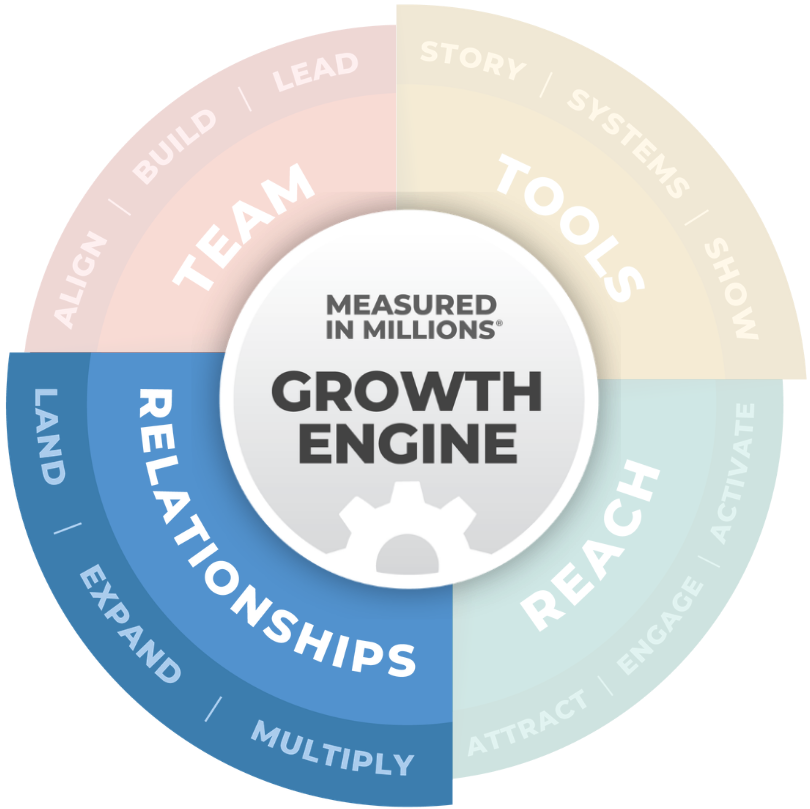
The MiM™ Growth Engine is a repeatable flywheel framework used to deliver programs, projects, and strategy the MiM™ way. It can be applied to anything — a website build, a trade show strategy, a six-month sprint of high-impact work, or a full business vision. The scale of the initiative doesn't matter. What matters is following the flywheel in order.
There are no set elements encapsulated in each step — rather, a way of operating. An engine that, when turned on, reliably creates forward motion.
The four quadrants move clockwise: Team → Tools → Reach → Relationships. That sequence is not arbitrary. It reflects how high-impact work actually gets done — and why most initiatives stall when that order is ignored.
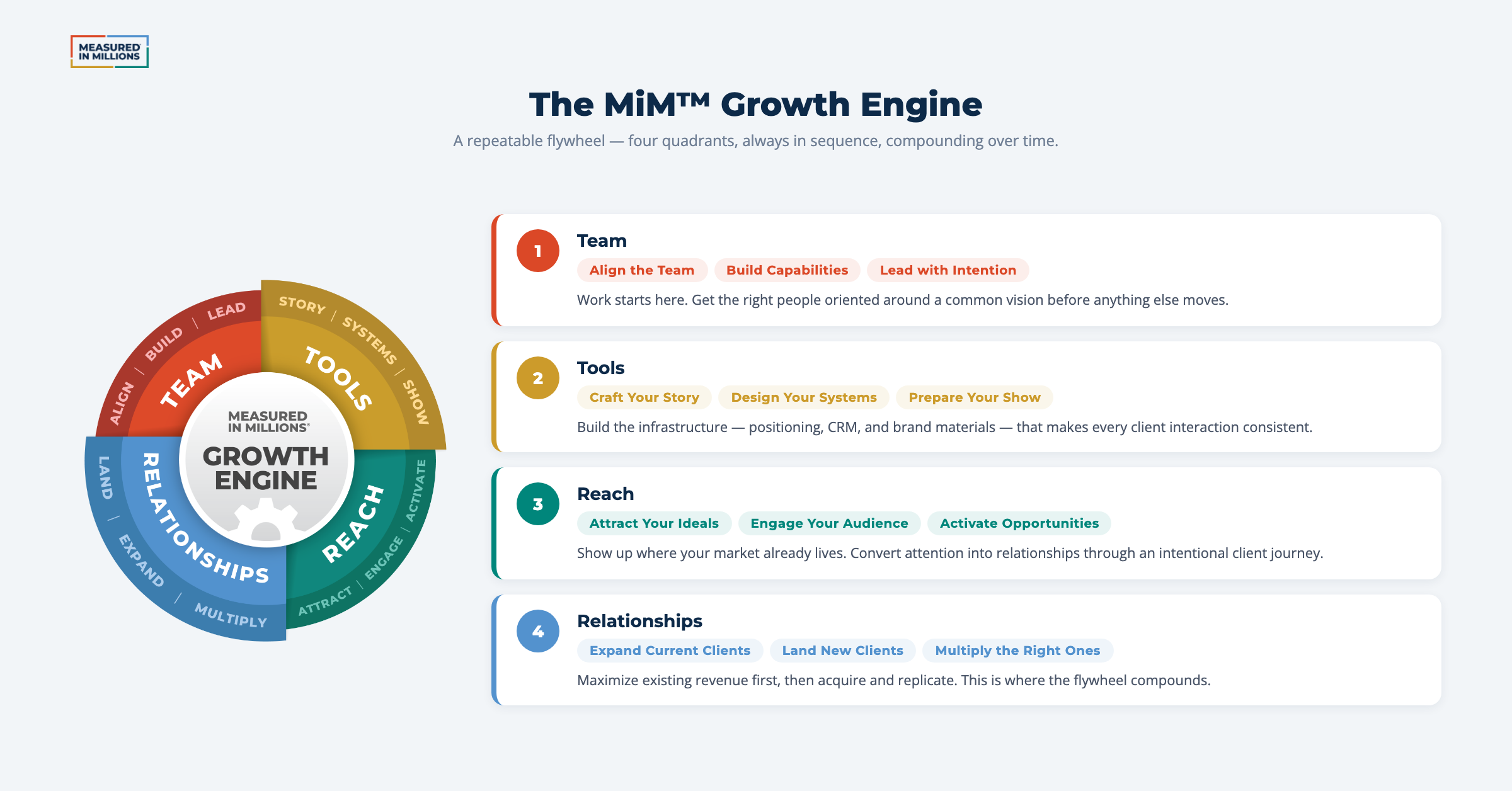
The Logic of the Order
Every initiative starts with people. Not strategy, not tools, not outreach — people. Until the right team is in place, aligned around a common vision, everything built on top of it is unstable.
From there, the work moves to tools — the story, systems, and infrastructure needed to support the team and make the initiative executable. Only once the team is aligned and the tools are ready does it make sense to reach an audience. And only after reaching and engaging the right people does the work of building lasting relationships begin.
The flywheel repeats. A provider might move through all four quadrants with a single focus on each, then circle back and go deeper on every pass. The number of rotations depends on the initiative. The order never changes.
Team
The first step in any initiative is ensuring the right people are in the room — with the right capabilities and the right leaders prepared to follow through on what has been decided and agreed upon.
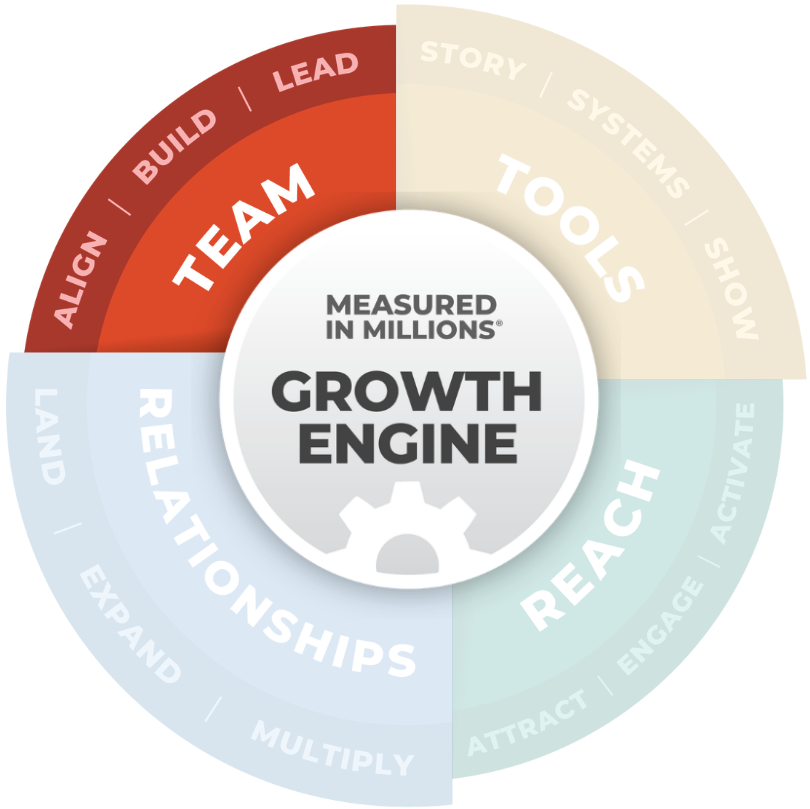
Align the Team
Choosing who needs to be involved and getting everyone oriented around a common vision and understanding of the objective. This is where the work of the initiative is defined and ownership is established.
Build Their Capibilities
If the team lacks what it needs to complete the objective well, this is the step where those gaps are identified and a decision is made about how to bridge them. That might mean bringing in a temporary resource, a freelancer, a full-time hire, or a fractional employee.
Lead with Intention
Once the team is aligned and capable, this phase holds everyone accountable to delivering on what was agreed. Decisions made in the room become decisions acted on outside of it. The real work begins when the meeting ends.
Tools
Once the right people are in place with the right capabilities, it is time to define the tools needed for the initiative.
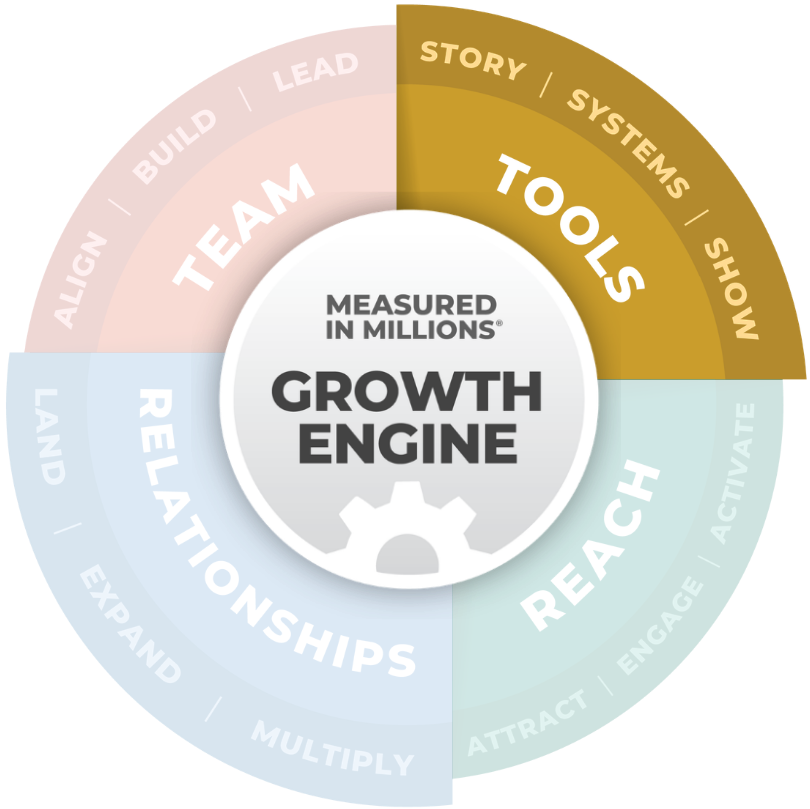
Craft Your Story
Positioning at every level. At a macro level, this is how the business speaks about its product, its offering, its value proposition, and how it intersects with the lives of its Ideal Relationships. At a micro level, it may be as specific as how a website articulates the company's purpose — or how a first meeting presentation frames the value of the engagement before a single question is asked.
Design Your Systems
The infrastructure that enables the team to execute. At a macro level, this includes CRM, sales technology, marketing technology, and operational systems. At a micro level, it may be as straightforward as linking a contact form on the website, setting up a subscriber list, or capturing the right information from people who have expressed interest.
Prepare Your Show
The external, visual expression of the story. Where Story is the language, Show is how the world perceives the business through brand identity, design, and presentation. At a macro level, this is the brand itself. At a micro level, it may be the website design, the first meeting presentation, or any client-facing material that signals readiness and credibility before the relationship deepens.
Reach
With the team aligned and the tools ready, the initiative is prepared to reach people. Priority Markets and Ideal Profiles have been identified. The goal now is to get in front of them through the right channels.
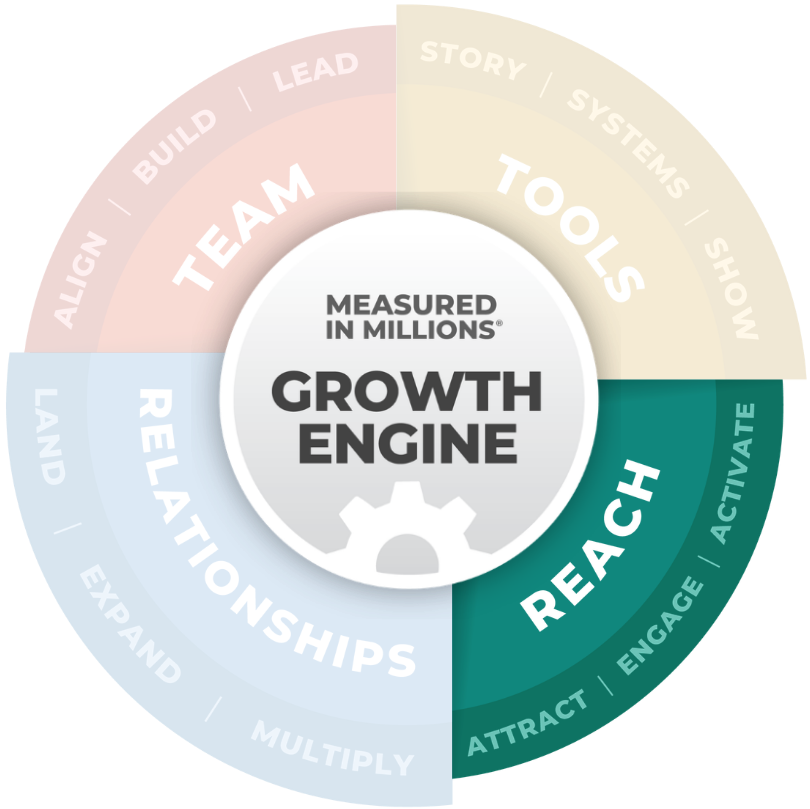
Attract Your Ideals
Showing up where the right people already are. MiM™ approaches this at three scales: 1:1 for high-value strategic relationships that warrant a highly personalized approach; 1:Few for groups of accounts that share common business attributes and challenges; and 1:Many for larger segments of ideal-fit accounts. The channels that tend to deliver the highest return for relationship-driven B2B companies are white papers, Lunch & Learns, webinars, and trade shows — environments where trust can be established before a sales conversation begins.
Engage Your Audience
Showing up well once attention has been earned. Engagement is not about volume — it is about proving worth. A first meeting presentation that is sharp, specific, and tailored to the audience signals competence before a word is spoken. A website that makes it easy for the right visitor to understand what the company does, who it serves, and how to take a next step does the work of engagement around the clock. Every touchpoint either earns a second interaction or doesn't.
Activate Your Opportunities
Converting attention into a budding relationship. Once someone has been attracted and engaged, the work shifts to delight. At a macro level, this means intentionally designing every touchpoint in the customer journey so nothing feels like an afterthought. At a micro level, it might mean thoughtful user design on the website so prospects can find what they need easily — or building a simple dashboard that gives a client real visibility into the value being created on their behalf.
Relationships
This is where the flywheel pays off. The work of Team, Tools, and Reach has created the conditions for real relationships to form and grow. This is where lifetime value is built.
Expand Your Current Relationships
Always start here. The quickest, warmest, easiest path to increased revenue is not a new customer — it is an existing one. Current customers already trust the business, already value what it delivers, and are already spending. Expanding those relationships starts with understanding how much they are spending annually, what percentage of that spend the business is currently capturing, and where additional value could be created. A customer spending $25,000 per year with the business but $100,000 per year in the category represents a significant expansion opportunity — one that requires no cold outreach, no trust-building from scratch, and no competitive positioning. It simply requires the conversation.
Land New Relationships
Landing new relationships comes after expansion has been addressed — not before. At a macro level, this means all marketing and sales efforts are oriented toward attracting new customers through the lens of the Ideal Profile. At a micro level, it asks whether the tools and infrastructure make it genuinely easy for the right prospect to find the business, understand what it offers, and take a first step.
Multiply the Right Relationships
Once the business knows which relationships are producing the most value, the goal is to replicate those outcomes. At a macro level, this looks like referral program design, managed community building, and customer rewards. At a micro level, it may mean making the referral program easy to find, offering meaningful recognition for customers who provide feedback or introductions, or creating experiences that make customers feel seen and valued. The goal is simple: ensure every customer has an experience worth talking about — then make it easy for them to talk about it.
The MiM™ Lens
Most businesses approach an initiative by deciding what needs to get done — then everyone starts working on different components simultaneously. The website team builds the site. The sales team starts outreach. The marketing team launches campaigns. Each effort is well-intentioned. None of them are connected.
The Growth Engine replaces that scattered approach with a deliberate sequence. Work always starts with alignment. From there, it moves to the highest-impact activities in the right order — ensuring that every layer of the initiative is built on a stable foundation before the next one begins.
The order is not a constraint. It is what makes the work compounding rather than fragmented.
Understanding the Operating System
The Growth Engine defines how the work gets done. The MiM™ Operating System defines the rhythm that sustains it — the structured cadence that moves a client company through the full MiM™ journey from clarity to compounding growth.
Click below to learn more about the MiM™ Operating System.
Chapter 1 Guide
The Methodology
- The MiM™ Methodology
- The 4 Philosophies of MiM™
- The MiM™ Growth Engine
- The MiM™ Operating System
The Client Journey
- The Quick Start
- The First 180
- Expansion & Optimization
- Continuous Improvement
The Roles That Deliver It
- Role of an MiM™ Coach
- Role of an MiM™ Architect
- Role of the MiM™ Studios