

What is a Sales Process?
A sales process is not a checklist. It is one half of a two-sided story.
On one side is the salesperson, moving a prospect through a series of relationship milestones. On the other side is the buyer, navigating their own purchasing journey — with their own timeline, priorities, and decision-making process. These two journeys run in parallel, and the best relationship builders know how to read both.
MiM™ maps the salesperson's side of that story through Four Gates.
Each gate marks a meaningful threshold in the relationship: a moment when something real has been established, confirmed, or won. A business that understands where every prospect stands relative to these gates knows exactly what needs to happen next. A business that doesn't is guessing.
The Four Gates apply universally. Whether a team is landing a brand new relationship or expanding within an existing account, the same progression holds. The gates don't change. The work required to move through them does.
Viewing the sales process as the other side of the buyer's journey coin reframes the salesperson's role entirely. The goal is no longer to advance an opportunity. It is to be a genuinely helpful partner to a prospect who may not have an opportunity to share yet. That posture — useful before the sale, not just during it — is what separates the relationship builders from the quota chasers.
Why It Matters
Most sales teams measure activity. Calls made. Emails sent. Meetings booked. These numbers feel like progress because they are easy to count. They rarely tell a team what it actually needs to know: where does each relationship stand, and what needs to happen next?
Without a shared framework for tracking relationship progression, sales teams operate on instinct. One salesperson considers a prospect qualified after a single conversation. Another waits until a contract is on the table. Leadership has no way to distinguish between a pipeline that is healthy and one that is full of wishful thinking.
The problem compounds at the buyer's end. A prospect who is not yet ready to share an opportunity still has a journey underway. They are researching, evaluating, building internal consensus. A salesperson who has no framework for reading that journey will either push too hard and damage the relationship or go quiet and lose the thread entirely.
The Four Gates solve for both sides. They give the sales team a common language for where every relationship stands. They give the relationship builder a lens for understanding where the buyer is in their own process — and how to be useful at every stage, not just the ones closest to a close.
The MiM™ Lens
If you walked into most companies today and asked what their sales process looks like and what sales tools they use, you would likely get ten different answers from ten different people. No two salespeople run their process the same way, and no buyer experiences the same standard of engagement twice.
That inconsistency has a cost. Buyers build trust through predictability. When the experience varies depending on who they talk to, the company cannot build the kind of repeatable process that earns confidence at every touchpoint.
The Four Gates solve for this by giving a team a shared map for the first time. When everyone is working from the same definition of what each gate means and what is required to cross it, the process becomes consistent. Trust compounds because the experience compounds.
A defined process is not a rigid script. It is a foundation. It gives salespeople the clarity to focus on the relationship rather than figuring out what comes next — and it gives the buyer a consistent, trustworthy experience at every stage of their journey.
The Four Gates
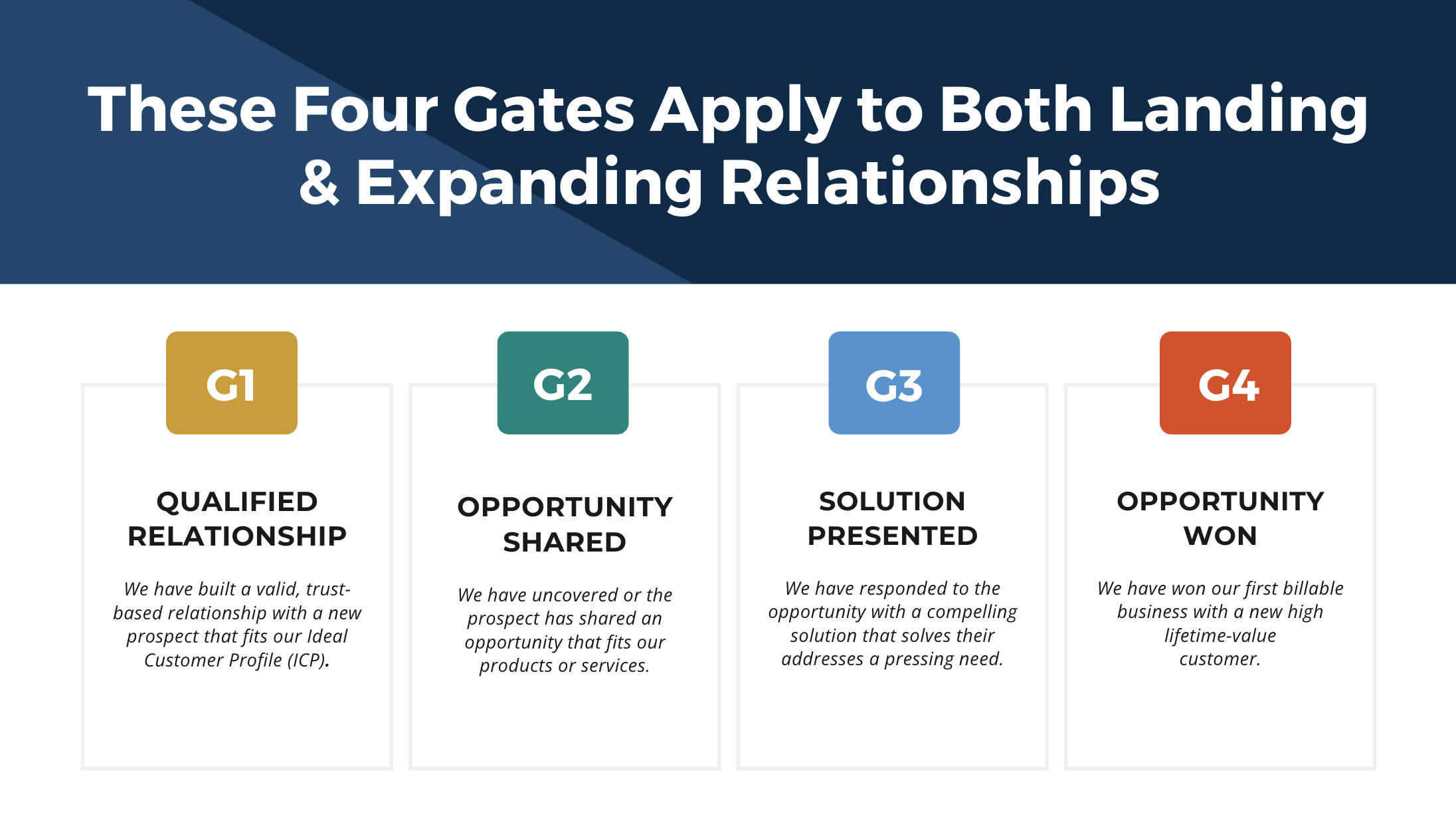
The Four Gates mark the key thresholds in any sales relationship — from first contact to closed business. Each gate represents a moment when something meaningful has been established. Crossing it requires real work. Claiming it before the work is done is how pipelines become fiction.
Gate 1: Qualified Relationship
The first gate is crossed when a genuine, trust-based connection has been made with a prospect who fits the company's Ideal Profile. Not a cold contact in a CRM. Not someone who opened an email. A real person who has engaged, shown interest, and been evaluated as a fit.
This is where the buyer's journey and the sales process first intersect. The prospect is becoming aware of a potential partner. The salesperson's job is to show up as useful, credible, and worth continuing the conversation with — nothing more.
- Meeting Type: The type of meeting you typically run in pursuit of crossing this gate is a First Meeting.
- Sales Tool: The sales tool most likely to support that conversation is a Capabilities Presentation or Intro Presentation.
Gate 2: Opportunity Shared
The second gate is crossed when a qualified prospect uncovers or shares an opportunity that fits the company's products or services. This is a significant moment. It means the relationship has developed enough that the buyer is willing to bring the salesperson into their world.
The distinction here is important. The opportunity is shared, not manufactured. A salesperson who has been genuinely helpful — present and useful before this moment arrived — earns this gate. One who has been pushing for it rarely does.
- Meeting Type: The type of meeting you typically run in pursuit of crossing this gate is a Technical Talks meeting.
Sales Tool: The sales tool most likely to support that conversation is a Sell Sheet or Brochure.
Gate 3: Solution Presented
The third gate is crossed when the team has responded to the opportunity with a compelling solution that addresses a pressing need. This is not a generic pitch. It is a tailored response to something real the prospect has surfaced.
Getting to this gate means the qualification was accurate, the relationship was strong enough to surface an opportunity, and the team was prepared to respond well. All three have to be true.
- Meeting Type: The type of meeting you typically run in pursuit of crossing this gate is a Proposal Preview.
Sales Tool: The sales tool most likely to support that conversation is a Proposal.
Gate 4: Opportunity Won
The fourth gate is crossed when the prospect commits to moving forward. The relationship is no longer potential — it is real. The trust built across every prior interaction, the quality of every meeting, and the strength of every tool that supported those conversations has compounded into a decision.
This gate does not close itself. It is the result of every gate before it being crossed with intention. Companies that treat G1 through G3 as a system rarely have to fight for G4. It arrives as a natural conclusion to a process that was designed to get there.
This Philosophy in Action
The Four Gates show up across MiM™ programs anywhere a client is building or improving how they land and expand relationships.
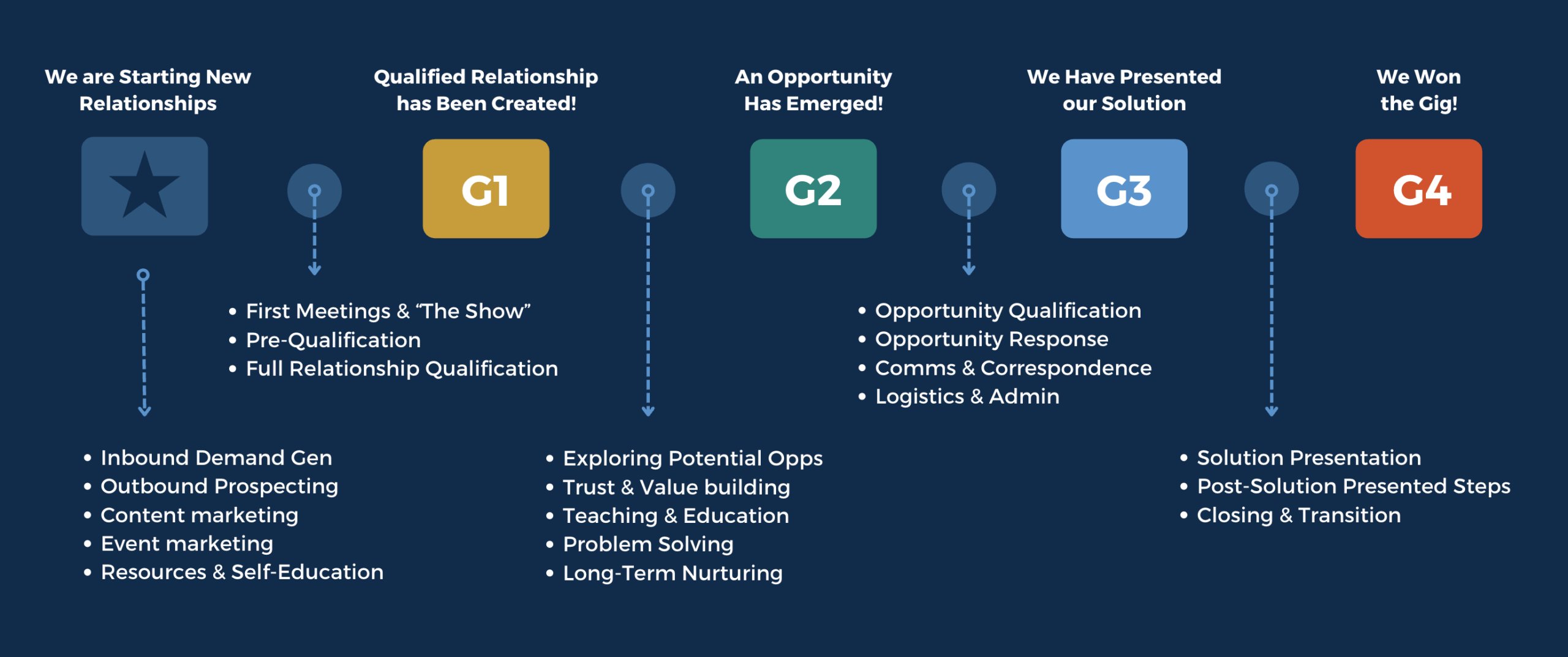
The most direct application is the First Impressions Suite. Before a MiM™ Coach and Architect can help a client build a stronger sales process, they need to understand where that process currently stands. The Sales Process Mapping session uses the Four Gates as the diagnostic framework — walking the sales team through how they currently move a relationship from first contact to closed business, what meetings support each stage, and where the gaps are. The Gates give the Coach a shared language to use with the client from the very first session.
Each gate has a meeting type and a sales tool that belong to it. To go deeper on either, start here: