

If you haven’t already, review the Growth Snapshot Philosophy page before facilitating this session. It explains why this workshop exists and how to think through the MiM™ lens when guiding the conversation.
Timing & Participation
Workshop: 1 of 6
Duration: 60 minutes
Led by: MiM™ Coach
Participants: CEO/President/Owner + full leadership team
This is the first workshop that uses the MiM™ Teach / Gather rhythm.
The session opens with a short teaching segment to establish shared context and expectations. The majority of the time is then spent in Gather, working live on the whiteboard to guide the leadership team through a structured walkthrough of how their current growth system operates.
Pre-work inputs—revenue streams, current and target margins, time-to-revenue, and growth goals—are used as context, not as items for validation or debate. The focus is on helping leaders narrate how the business arrived at its current state and where the system appears aligned or unclear.
The Coach’s role is to facilitate usable clarity, keeping the conversation at the system level and preventing it from turning into a data review or solutioning session.
This workshop establishes a shared baseline understanding that the rest of Quick Start™ builds on.
Preparation
Time Required: 15–20 minutes
Lead: MiM™ Coach
Timing: 1–2 days before the workshop
Preparation for the Growth Snapshot is intentionally light. The goal is to prime leadership thinking so the session surfaces patterns quickly — not to validate data or debate numbers.
Use the steps below to prep for your Growth Snapshot session.
1. Send Prep Email
Email to the Team
To: Client Team
Cc: MiM™ Architect
Subject: Workshop 1: Growth Snapshot Prep
----------------
Hi team,
Looking forward to our upcoming Growth Snapshot workshop.
The goal of this session is to ground our work in how the business actually makes money today so we can make smart, aligned decisions about where growth efforts should focus next, with a shared understanding of what’s already in place. Everything that follows in the remaining workshops builds on this foundation.
To make the most of our time together, it will be helpful to come prepared with a clear view of a few core areas. This doesn’t need to be perfect or overly polished—directional clarity is enough.
Ahead of the workshop, please plan to gather:
- Current company growth goals (revenue, profitability, scale, or mix)
- A breakdown of your current revenue streams (products, services, retainers, etc.)
- Approximate revenue contribution by stream
- Approximate profit margins by stream (even ranges are fine)
- Your primary sales channels and how revenue flows through them
- Any revenue areas you believe should grow, shrink, or sunset over time
If you already have this information pulled together, feel free to send it over in advance - I’ll use it to prep our session and tailor the conversation to your business.
We’ll use this information to identify what to keep, what to build, and where focus will create the most impact with the least friction.
If you have questions as you prep, feel free to reach out. Otherwise, we’ll walk through everything together in the session.
Looking forward to the conversation,
MiM™ Coach
Reminder: Calendar Invite
This should already be on the calendar at this point, but as a quick reference, this is your calendar invite.
*Client Name* // Workshop 1: Growth Snapshot
Required: Client leader, Client team, MiM™ Coach, MiM™ Architect
----------------Meeting Room: *Zoom or Teams info*
Purpose: In this session, we’ll walk through your revenue streams, sales channels, and company goals to understand how revenue moves through your business today and how that aligns with your growth goals. You’ll receive a short prep email beforehand with a few specifics to gather so we can hit the ground running.
2. Review the Teach Deck
- Open the Quick Start™ - Growth Snapshot Teach Deck in Canva
- Use Presenter View to review your speaking notes
- Practice transitions
- Focus on flow, not memorization
This session is a teaching performance — you need to be fluent, confident, and conversational.
3. Review Answers
If you receive answers back from the client via email, use them to start filling in your whiteboard.
Teach
Time: ~10-15 minutes
Lead: MiM™ Coach
Use the presentation deck as your guide. The notes inside contain the full flow, pacing, transitions, and phrasing. Your job is to stay present, keep the energy steady, and anchor everything in relationships.
Once you complete the teaching portion, exit Presenter Mode and switch to the client's Working Whiteboard to start the Gather portion.
Gather
Time: ~45–50 minutes
Lead: MiM™ Coach
The Gather portion of the Growth Snapshot is intentionally open-ended. This conversation can—and often will—move in different directions depending on the leadership team’s level of clarity and alignment.
As the coach, your role is to follow the threads that emerge and dig deeper where needed, without forcing the conversation toward solutions or decisions.
While the inputs focus on revenue streams, sales channels, and growth goals, the underlying objective of Gather is to determine one of three outcomes by the end of the session:
- There is no clear path to the growth goal
- There is a fuzzy or assumed path to the growth goal
- There is a clear and shared path to the growth goal
Use the whiteboard to anchor the discussion, but allow the conversation to expand where misalignment, uncertainty, or assumptions surface.
Common scenarios you may encounter include:
- Growth goals exist, but there is no agreed plan to reach them
- A plan exists, but leaders describe it differently
- Revenue streams are driving growth incidentally rather than intentionally
- Sales channels are operating in ways leadership did not fully anticipate
- Growth depends heavily on one stream or channel without explicit acknowledgment
Your job in Gather is not to resolve these situations, but to surface them clearly enough that the leadership team can recognize which state they are in.
By the end of Gather, the room should be able to answer—collectively and honestly—whether their current growth system supports their goals, partially supports them, or does not support them at all.
That clarity is what enables Synthesize to be decisive.
💡 Facilitation Tip: The session is recorded. Fathom will capture the conversation, so if a detail gets missed in the moment, you can always revisit the recording and fill in gaps afterward. Don’t slow the room down chasing perfection — keep the energy moving forward.
Immediate Follow-Up (End of Session)
At the close of the Gather portion, send a short follow-up email to the client team, ideally within a few hours.
Follow-Up Email
From: MiM™ Coach
To: Client Team
Cc: MiM™ Architect
Subject: Workshop 1: Growth SnapshotFollow Up
—————-
Hi team,
Thanks again for your time in today’s Growth Snapshot session. This workshop gave us a shared view of how revenue moves through your business today and where strengths, gaps, and open questions are emerging.
Our next step is to review what we gathered together. We’ll be pulling out patterns, pressure points, and key themes that will inform your Week 6 session, where we’ll present a clear path forward based on what we’ve learned.
As a reminder, the playbook is reserved for decisions you want the entire company aligned around. Since the first three workshops are diagnostic, most of what we covered remains in assessment mode for now. That said, if an area is already operating at a level we recommend—such as a revenue stream with healthy margins and predictable time-to-revenue—we’ll capture that in your playbook so your team has clarity on what’s working and why.
You’ll see a prep email from me next week ahead of our Growth Roles session. In the meantime, if any questions come up, don’t hesitate to reach out.
Best,
MiM™ Coach
Synthesize
Synthesize is where you organize the output of the workshop into decisions, inputs, and future guidance.
Your job in this step is to distill the conversation into a clear growth model—while being precise about where each piece of information belongs.
Start by documenting everything that was surfaced:
-
Stated growth goals
-
Revenue streams and sales channels discussed
-
Gross profit margin and time-to-revenue for each revenue stream
-
Leadership assumptions about what is driving or limiting growth
From there, distill the model. You should be able to clearly identify:
-
The primary revenue source and primary sales channel
-
Secondary revenue sources and channels
-
Which streams are margin-driven, volume-driven, or relationship-driven
-
Where leadership believes growth will actually come from
This is where you pressure-test questions like:
-
Should this continue to be our primary revenue source?
-
Is margin expansion a faster path to the goal than net-new revenue?
-
Are we under-monetizing customers or products we already have?
-
Is the constraint sales efficiency, delivery efficiency, or pricing?
Use profit margin and time-to-revenue to ground these conversations. Just like with customers, growth often comes from earning more from what already works—through pricing, efficiency, or wallet share—before adding complexity.
Next, separate decisions from unresolved disagreement.
Only items that leadership has clearly agreed the company will align around belong in the Growth Model Playbook. These are enterprise-level decisions.
Anything that is unclear, contested, or unresolved is still documented—but kept in leadership-only notes. Do not force alignment to “finish the page.”
Finally, translate what you observed into preliminary recommendations. These are not presented to the client yet. They are inputs you will carry forward and refine as you move through the remaining sessions.
These observations and recommendations are building toward your First 180™ recommendations, which are formally presented in Session 6. Your goal here is to capture signal early—so by the time you reach that session, your guidance is grounded in what leadership actually said, agreed to, and struggled to align on.
You may use the Growth Model Advisor GPT to help synthesize and distill the conversation by uploading the workshop transcript. This works only if the topics above were explicitly surfaced and discussed during the session.
Share
The Growth Model Playbook page already exists in the client’s Playbook template.
After the Growth Snapshot workshop, update that page to reflect the finalized decisions captured during Synthesize.
Below is an example of what the Growth Roles Playbook page will largely look like once the session is complete.
Example: Growth Model Playbook Page
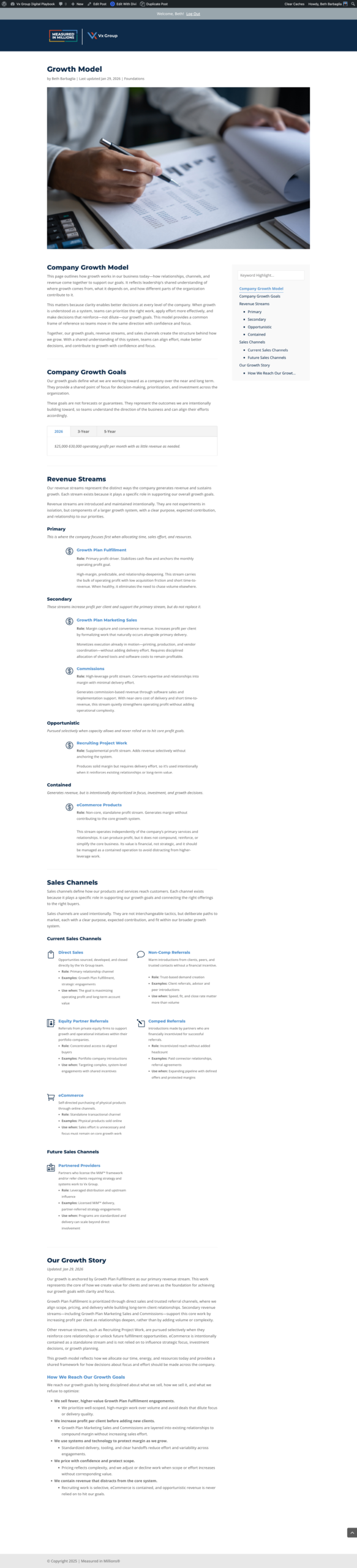
Use the template as your starting point and tailor it to the client’s business. Stay as true to the structure as possible, but remove sections that clearly do not apply. For example, if the company only has primary and secondary revenue streams or sales channels, it is appropriate to cut the remaining sections rather than force artificial complexity.
If sections of the model were not finalized, leave them incomplete.
Once the page is updated, share it with the client using the provided email template.
Share Email
From: MiM™ Coach
To: Client Team
Cc: MiM™ Architect
Subject: Playbook Page Update: Growth Model
—————-
Hi team,
Following our Growth Snapshot session, we’ve updated your Growth Model Playbook page to reflect the information we aligned on during the workshop.
This page captures your current-state growth model and will serve as a shared reference as we move forward. You can review it here:
*Insert link to Playbook page*
This page communicates your growth goals, how you plan to reach them, and which revenue streams and sales channels drive that plan.
If this doesn’t reflect what you’d confidently share with your team, let’s make edits. Otherwise, I’ll see you soon for our next session.
Best,
MiM™ Coach
What's Next
Next, you’ll lead the team through the Growth Roles workshop, where the focus shifts from how growth works to who owns growth across the organization.
Review the Growth Roles Philosophy before facilitating the session, then use the toolkit to guide the conversation.